what might mahfouz be trying to say about the "passage of time" in his story "half a day"
Digesting: "Half a Twenty-four hour period" by Naguib Mahfouz
Link to "Half a Day": http://coachcenglish.weebly.com/uploads/ane/three/iii/7/13371658/half_a_day.pdf
What is information technology?
A short story written by Naguib Mahfouz published in 1989.
Synopsis
A narrator goes to school and ages throughout most of their life seemingly during the same twenty-four hour period.
"I felt I was a stranger who had lost his mode" -Naguib Mahfouz, "Half a Day".
Understanding
The unnamed narrator is seemingly experiencing his first day of school, simply as the story progresses we see that he is fusing that story with the story of his life. This becomes clearer when the narrator meets a middle-aged associate familiar to him: "After I had taken a few steps, a middle-aged man passed past, and I realized at once that I knew him. He came toward me, grinning, and shook me by the hand, maxim, 'It's a long fourth dimension since we last met — how are you?'" This quote shows us the transition into centre-age. Until now, the narrator was conveying the story of his first day of school, but in adding the line: "'It's a long time since we last met," Mahfouz is showing how much time has passed, that it's not just the ane school day every bit readers have been led to believe. This passage of time is further portrayed during the last sentence when nosotros learn that the narrator has reached old age: "He stretched out his arm and said gallantly, 'Granddad, allow me take you across.'" This quote portrays the narrator every bit an elderly gramps who needs help crossing the route, and what I notice most effective about it is how the kid assisting the narrator across the street is likely around the aforementioned age as the narrator was when he first started school.
Simply what'southward with this passage of time? Well-nigh of the story seemingly takes place during the narrator's offset solar day of schoolhouse, but this is not truthful because the narrator telling the story is non a kid when the story begins, as shown past the showtime sentence which states: "I proceeded alongside my father". Kids practice not speak like this, and in utilizing such an eloquent, fluid tone Mahfouz is hinting to the reader that it is an older homo narrating the story of his life, starting with the beginning of his get-go schoolhouse mean solar day. Almost of his story is this commencement mean solar day, and in one case the school day is finished we see him crumbling quickly. This is meaning because this story is showing us how quickly life passes the states by. During youth, especially while in school, the days seemed longer; but ane matter that I have institute out as I age is that days become past so much faster, years aren't well-nigh equally long every bit they once seemed. "Half a Day" shows us that time volition pass past quicker than we know it, and 1 day we'll exist erstwhile and we'll wonder where all of the time went.
"'Here too there are mothers and fathers. Here there is everything that is enjoyable and beneficial to noesis and faith. Dry your tears and face life joyfully.'" -Naguib Mahfouz, "Half a Twenty-four hours".
What's with the title?
"Half a Day" both is and isn't ironic considering that the narrative does literally tell the story of half a day of the narrator'due south life, simply also tells the story of his whole life which far surpasses the half-day limit the title implies. What'due south important virtually this irony is that information technology shows us readers how quickly fourth dimension flies by as nosotros age. To both reader and narrator it may seem similar only a one-half a day has gone past, but in reality, most of the narrator'southward life has passed him.
Something Cool
As I've somewhat touched on higher up, I love how subtly the narrator ages. Mahfouz doesn't fifty-fifty explicitly confirm that the narrator has aged; instead, the reader is left to infer it from the narrator's interactions with the middle-aged human being and the young boy who calls him grandpa.
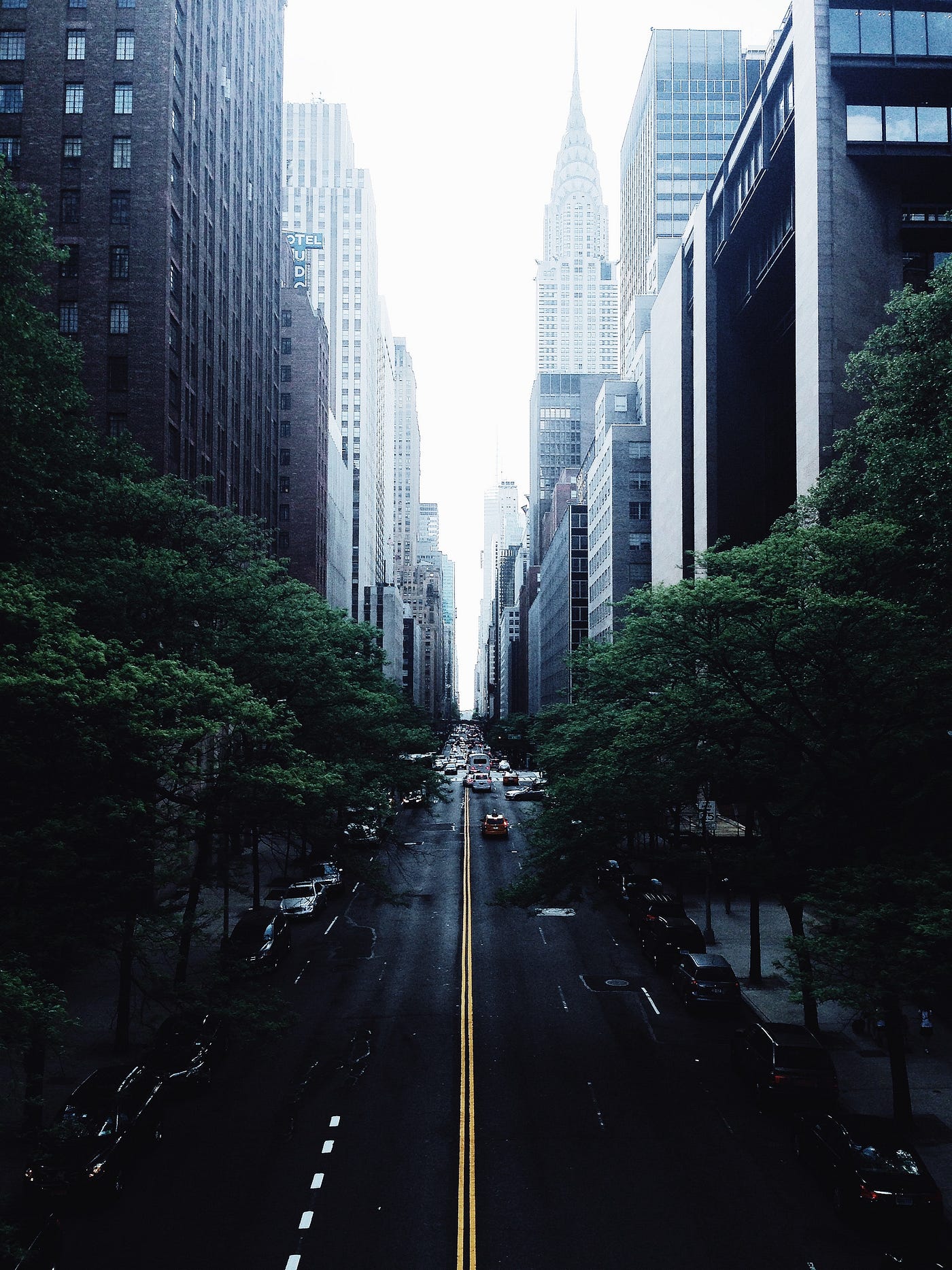
I likewise call up information technology'southward cool how Mahfouz tells the story of environmental industrialization and how the narrator grows upward and ages forth with his setting. "Where was the street lined with gardens? Where had it disappeared to? When did all of these vehicles invade it? And when did all these hordes of humanity come to residuum upon its surface? How did these hills turn down to cover its sides? And where were the fields that bordered it? High buildings had taken over, the street surged with children, and disturbing noises shook the air." Although Mahfouz may not be telling the story of your verbal environment, it certainly is a tale familiar with anyone who has been in and out of a big city. There is certain signal where nature begins to fade and the loftier buildings, smoke and smog start to accept over in these major cities, and Mahfouz chronicles that brilliantly. I too savour how it is tied into age. When I was younger I never noticed the lack of nature and the complete takeover of industrialization. Merely when I was much older did I begin to notice this absence of nature, and "Half a Twenty-four hours" captures this exact predicament perfectly.
"Living beings were fatigued to other living beings, and from the first moments my middle made friends with such boys as were to be my friends and fell in dearest with such girls every bit I was to be in beloved with" -Naguib Mahfouz, "Half a Twenty-four hours".
What near you?
Do you feel like time flies past the older you get? Compared to your youth and school days, how is life now? Later on school did your life seem to become past quicker? "One-half a Day" teaches us to appreciate the present because the days go past quick, especially the older we get, and before nosotros know it nosotros'll be sometime and aged and our lives volition be almost over.
What about me?
I really wish I would accept been taught this story in high school, I think it holds such a valuable, important lesson, especially for teenagers. Although I had a dandy high school experience (for the most office), I wish I would take appreciated information technology more than and done more things because I feel similar I accept missed out on a lot of opportunities. Now that I am out of high schoolhouse I experience like life is on fast-forward. This story could accept taught me to appreciate my high schoolhouse days because they'll be over then much quicker than I would always expect, and maybe in knowing this I would accept made dissimilar choices throughout those four crucial years.
Questions to consider
What role does ambiguity play when the narrator describes his school day?
What does the narrator learn during schoolhouse and in what mode are those lessons significant?
What is the significance of the narrator being unable to find his father?
Source: https://medium.com/digestable-literature/digesting-half-a-day-by-naguib-mahfouz-74efd9d99f8f
0 Response to "what might mahfouz be trying to say about the "passage of time" in his story "half a day""
Post a Comment