What Do You Call Art That Looks Like Different Things
This postal service may contain affiliate links. If you make a buy, My Modern Met may earn an affiliate committee. Delight read our disclosure for more info.
Like whatsoever creative field, art history has its own linguistic communication. While this reality can exist overwhelming for aspiring art historians, having a handy glossary of fine art terms can make analyzing a piece of work of art a lot less intimidating.
In this list, you'll discover 25 words that will assistance you talk over art with ease. Ranging from general concepts, similar brushwork and composition, to specific techniques, including chiaroscuroandtrompe 50'oeil, this arsenal of art terms offers everything you demand to make the about out of your next museum visit.
Analyze art like a professional person with this art history glossary.
Abstruse
Breaking away from the figurative representation of objects,abstract art reimagines imagery as a study of the relationship between shape, form, color, and line. Abstraction occurs on a continuum, including the fractured-still-recognizable forms of Cubism and the totally non-pictorial nature of Abstract Expressionism.
Aerial Perspective
As known as atmospheric perspective, this method for creating depth in ii-dimensional artworks focuses on the idea that the further an object is from the foreground, the lighter in tone and hue the color volition be. By exaggerating the difference in these tones, artists can use aerial perspective to create drama and establish the illusion of space on the picture airplane.
Aggregation
This creative form or medium uses a mix of materials that create three-dimensional layers from a stock-still based. The usage of different materials makes information technology like to collage, but in a three-dimensional form. Assemblage has its origins in Cubism and the work of artists like Human being Ray and Vladimir Tatlin, who frequently used found objects in their artwork.
Advanced
The French term advanced literally translates to "accelerate guard," but is used to describe artworks, movements, or artists that are experimental and forward-thinking.
Biomorphic
Biomorphic artwork is art that, while remaining abstract, evokes the course and shape of natural and living organisms. The term was offset used relating to art in the mid-1930s and has been connected with Surrealism and Cubism. Antoni Gaudí'south Sagrada Familia is an case of architecture that has been characterized as biomorphic.
Brushwork
Brushwork refers to the way a painter applies paint to a surface. It is typically characterized past the size, texture, and precision of the strokes. For case, brushstroke may exist described as "tight" or "loose" depending on how visible they are to the naked eye.
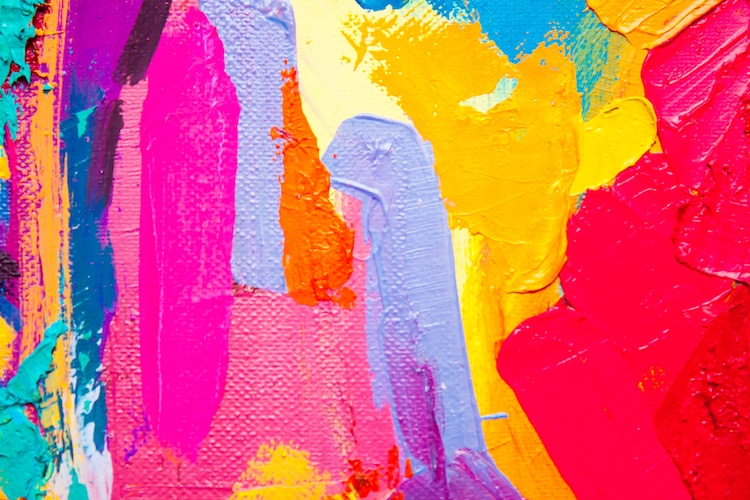
Oil painting on canvas (Photo: Stock Photos from Sweet Art/Shutterstock)
Chiaroscuro
Italian for "light-dark," chiaroscuro is the apply of strong contrasts between luminosity and shadow to reach a sense of volume and dimensionality. This unique technique was developed during the Italian Renaissance by Leonard da Vinci, the Bizarre menses by Caravaggio, and the Dutch Aureate Age by Rembrandt.
Limerick
The limerick of a work of fine art is the way in which its visual elements are arranged, especially in relationship to one another.
Conceptual
This 20th-century fine art form developed in the 1960s, when artists began to emphasize ideas and concepts over the finished product. Art that is conceptual breaks free from all the standard rules and tin take any class from sculpture and painting to happenings and performances.
Contour
As the outline of something, the contour is ane of the edifice blocks of drawing. Using different profile lines tin dramatically change the way an artwork appears and is well-nigh evident in line art.The Danceby Henri Matisse is only 1 instance of a work of art known for its singled-out contours.
Contrapposto
In sculpture, contrapposto ("counterpose" in Italian) is an asymmetrical posture in which most of a figure'southward weight is distributed onto one foot. This results in a realistic stance, as famously evident in Michelangelo'sDavid statue.
Figurative
A work of art is considered figurative when its subject affair is representational.
Foreground
The foreground of a work of art is the part of the composition that is closest to the viewer. It is typically discernible from the background, which appears to be further abroad.
Foreshortening
Foreshortening is a technique in which an creative person distorts perspective to evoke an illusion of depth. Foreshortened subjects often appear to recede into the motion picture plane.
Genre
A genre refers to a blazon of art (typically painting). Examples of genres include landscape and still life.
Iconography
Iconography refers to the subject matter, or images, used to convey meaning or communicate a bulletin in a work of art.
Impasto
This Italian give-and-take for "mixture" refers to thick layers of pigment used to create texture. While information technology was first used by Venetian painters during the Italian Renaissance, information technology really took hold in the 19th century. Renowned mural painter J.M.W. Turner used impasto to build layers of color and drama in his work. Painters often employ palette knives for this technique, which is meant to emphasize their talent in manipulating their chosen medium.
Medium
A medium is the material used to create fine art. Examples of mediums are watercolor pigment, oil, pastel, marble, and charcoal.
Modern
As a movement, the term "modern" refers to art created between the onset of Impressionism and Pop Art, which ushered in contemporary fine art. On a more general scale, however, "mod" tin mean current or cutting-edge.
Motif
In the visual arts, a motif is an element of iconography. In paintings, a motif can refer to whatsoever pictorial feature of the limerick. In the decorative arts and architecture, information technology often denotes a recognizable symbol that repeats.
Narrative
Narrative, in terms of art history, is the visual storytelling that occurs within a piece of art. While non every piece of art will accept a clear story, narrative art asks painters and sculptors to employ visual cues in order to atomic number 82 viewers through a series of events.
Pentimento
Pentimento ("repentance" in Italian) refers to the presence of bear witness that an creative person has painted over a previously-rendered subject area. In The One-time Guitarist by Pablo Picasso, for example, the vague outline of a woman's face is credible below the terminal brushstrokes.
Perspective
Perspective is the representation of three-dimensional depth and infinite on a flat surface. In that location are ii master types of perspective: linear and atmospheric. Linear perspective employs intersecting lines and vanishing points equally a means to make objects appear far away. According to Leonardo da Vinci in A Treatise on Painting, atmospheric perspective, on the other hand, illustrates the thought that "colors become weaker in proportion to their distance from the person who is looking at them" through tonal changes.
Scale
Calibration refers to the size of an object in relation to another. Oft, equally in the case of big-scale paintings, this comparison is based on the portrayed object's real-life size.
Sfumato
Predominantly associated with the paintings of Leonardo da Vinci, sfumato (derived fromfumo or "smoke" in Italian) is a method of shading and color-blending that evokes a soft, "smoky" haze. This technique is apparent in the blurred background and softly-defined facial features of the Mona Lisa.
Style
A work of art'southward style is a classification of its visual appearance. Often, manner is characterized according to the distinctive aesthetic arroyo of an individual artist, art movement, menstruation, or culture.
Tone
Tone refers to the lightness or darkness of a detail color.
Trompe fifty'oeil
In French, trompe fifty'oeil means "deceive the middle." Information technology is a technique that creates optical illusions of three-dimensionality past employing eye-catching lifelike imagery.
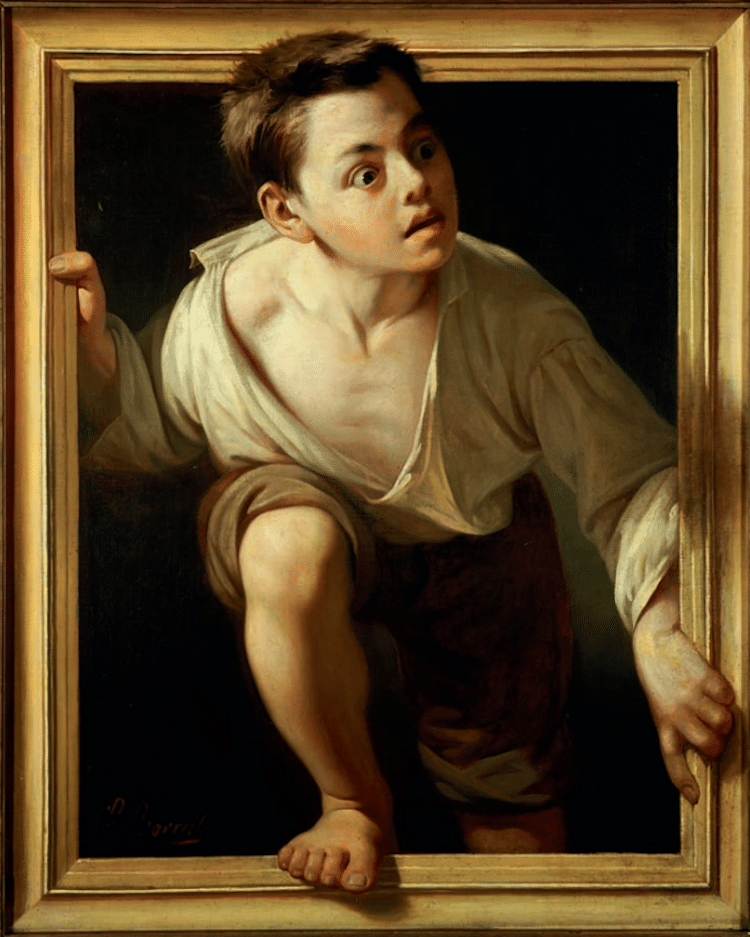
Pere Borrell del Caso, 'Escaping Criticism' (1874) (Photo: Collection Banco de España via Wikimedia Commons Public Domain)
Now that yous've grasped the basic terms, master Fine art History 101 with these must-have fine art history books.
This article has been edited and updated.
Related Manufactures:
xv Must-Take Fine art Books for the Creative Mind
10 Inspiring Children's Books for Budding Piddling Artists
Tate Digitizes Rare Excerpts from Famous Artists' Sketchbooks, Letters, and Photos
Metropolitan Museum of Art At present Offers Over i,600 Free Fine art Books Online
Source: https://mymodernmet.com/art-history-terms/
0 Response to "What Do You Call Art That Looks Like Different Things"
Post a Comment